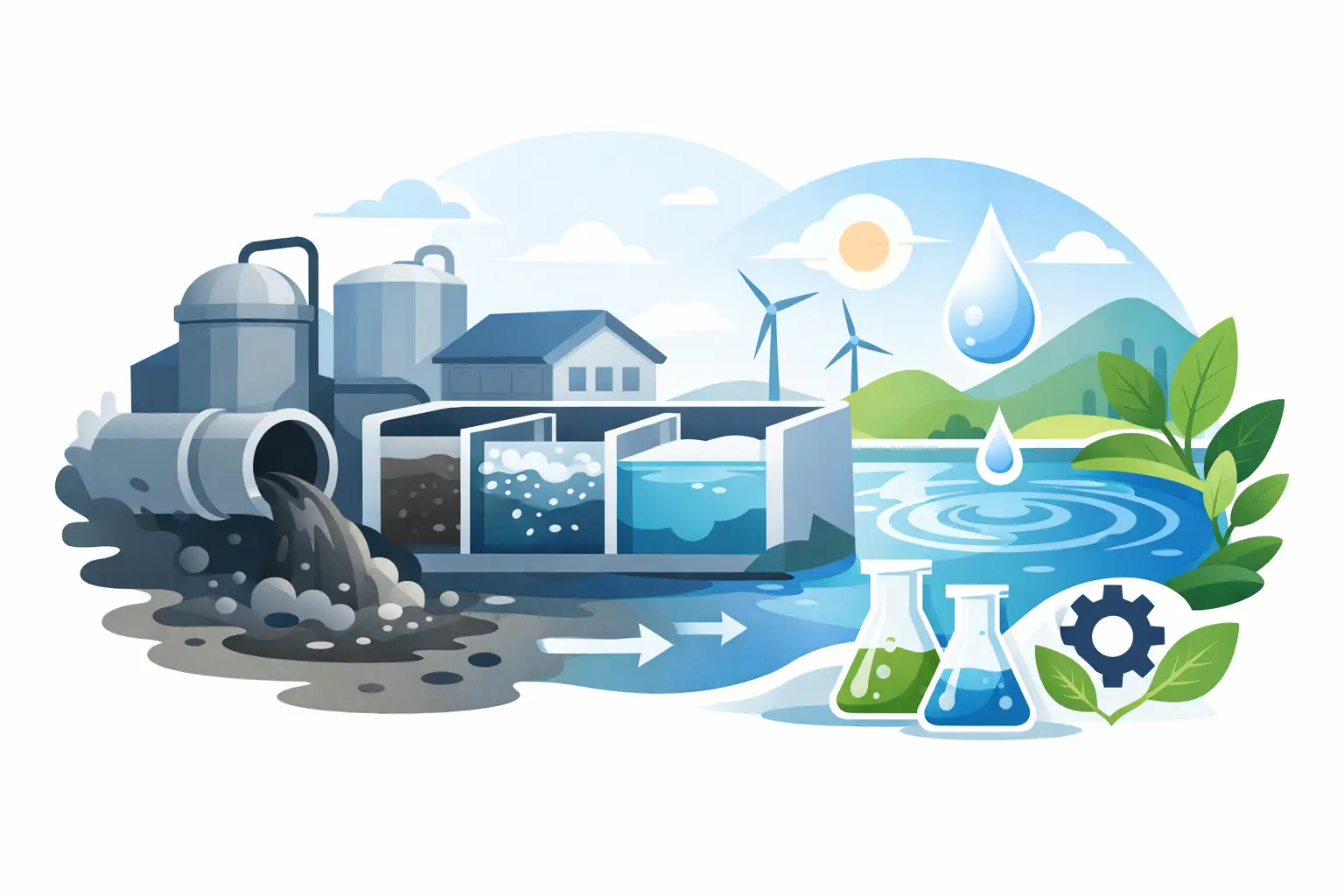
COD problems usually show up where costs are already climbing. Hauling bills rise, discharge limits tighten, sludge handling gets harder, and operators are left asking how to reduce COD in wastewater without adding another chemical program that creates new problems downstream.
For industrial facilities, COD is not just a lab number. It is a direct indicator of organic load, treatment difficulty, and total operating burden. When COD stays high, disposal costs tend to stay high with it. The right reduction strategy depends on wastewater composition, required discharge quality, existing infrastructure, and whether the goal is compliance, reuse, volume reduction, or all three.
What COD really tells you
Chemical oxygen demand measures the amount of oxidizable material in wastewater. In practical plant terms, high COD signals that the stream contains dissolved or suspended contaminants that will consume oxygen during treatment or in the receiving environment. That often includes oils, organics, solvents, process residues, surfactants, and oxidation-resistant compounds.
COD matters because it affects more than permit performance. It influences aeration demand, treatment chemical consumption, sludge generation, biological system stability, and the cost of off-site disposal. If your plant is treating complex industrial effluent, COD is often the parameter that reveals whether the current process is actually working or simply managing symptoms.
How to reduce COD in wastewater: start with the source
The fastest way to waste money is to treat all wastewater as if it were the same stream. Industrial COD reduction begins with segregation and characterization. A low-strength rinse stream should not be handled the same way as a concentrated reject, spent bath, washdown stream, or contaminated condensate.
Sample the wastewater by source, not only at the final equalization tank. Review COD alongside pH, TSS, oil and grease, conductivity, ammonia, and flow variation. Also determine whether the COD is readily biodegradable, partially biodegradable, or largely refractory. That distinction drives technology selection.
Source reduction can deliver meaningful COD cuts before treatment even starts. Better chemical housekeeping, drag-out recovery, improved rinse management, leak control, and tighter process dosing can lower the organic load entering the wastewater system. These measures are often low-capex, but they rarely solve high-COD industrial wastewater on their own when the stream is chemically complex.
Match the treatment method to the COD type
There is no single best method for every facility. The right answer depends on whether the COD is suspended, dissolved, biodegradable, toxic to biology, or resistant to conventional oxidation.
Physical separation for particulate and oil-based COD
If a large share of COD is tied up in suspended solids, free oil, or emulsified material, physical pretreatment should come first. Screening, dissolved air flotation, oil-water separation, and filtration can remove a meaningful portion of load before downstream treatment. This reduces system stress and lowers operating cost in the next stage.
The limitation is simple. Physical systems do not remove dissolved COD effectively. If the wastewater contains soluble organics, solvents, detergents, or fine emulsions, physical separation alone will not get you where you need to go.
Chemical treatment for targeted removal
Coagulation, flocculation, pH adjustment, and oxidation chemistry are widely used to reduce COD. These methods can work well when the wastewater is consistent and the contaminants respond predictably to chemicals. For some facilities, especially where capital budgets are tight, conventional chemical treatment remains the default option.
But there are trade-offs. Chemical programs can become expensive at high loadings. They often generate sludge, increase handling complexity, and require continuous operator attention. If your wastewater varies by shift, batch, or product line, chemical optimization can turn into a constant adjustment exercise.
Biological treatment for biodegradable COD
When COD is largely biodegradable and toxicity is controlled, aerobic or anaerobic biological treatment can be effective. Activated sludge, MBR systems, and anaerobic reactors are established tools for reducing organic load.
Still, biology has limits in industrial settings. Shock loads, temperature swings, salinity, surfactants, solvents, and antimicrobial compounds can destabilize the process. Biology also needs space, controls, and time. Plants with difficult wastewater or intermittent production often find that biological treatment performs well on paper but inconsistently in real operating conditions.
Advanced oxidation for hard-to-treat industrial COD
When wastewater contains refractory organics or compounds that resist conventional treatment, advanced oxidation becomes much more relevant. Advanced Oxidation Process technology works by generating highly reactive species that break down complex organics into simpler compounds. For industrial operators, that means treating COD that standard physical, chemical, or biological steps may leave behind.
This approach is especially useful where the wastewater has color, odor, persistent organics, or variable chemistry. It can also reduce dependence on large chemical dosing programs when engineered properly. The key is process design. Not every oxidation system is equal, and performance depends on wastewater matrix, contact conditions, and integration with the rest of the treatment train.
Why evaporation changes the COD equation
In many industrial facilities, the real cost problem is not only COD concentration. It is wastewater volume. If you are hauling large volumes of difficult effluent, your operating cost is driven by both contamination level and total gallons managed.
That is where vacuum evaporation can shift the economics. Instead of trying to force every stream through conventional treatment, evaporation concentrates the waste and dramatically reduces the liquid volume requiring disposal. Clean distillate can often be recovered, while the high-strength residue is minimized for final handling.
For plants dealing with non-biologically treatable wastewater, high TDS, variable chemistry, or expensive off-site hauling, this is often the difference between managing wastewater and controlling it. A properly engineered vacuum evaporator also avoids many of the sludge and chemical handling burdens that come with conventional treatment.
AQUAMAZ applies this model with zero-chemical treatment and integrated Advanced Oxidation Process capability, giving facilities a practical path to reduce difficult COD while cutting wastewater management costs by up to 90% in the right application.
How to choose the right COD reduction strategy
If your goal is to understand how to reduce COD in wastewater at an industrial site, start by defining the business case, not just the lab target. Some plants need permit compliance. Others need to cut hauling cost. Others need water recovery or lower chemical use. Those goals can point to very different system designs.
A stable, biodegradable wastewater with available footprint may justify biological treatment. A stream dominated by suspended contamination may respond well to separation and clarification. But if the wastewater is concentrated, variable, chemically complex, or costly to dispose of, volume reduction with advanced oxidation support can be the stronger operational choice.
This is where pilot data matters. Bench tests, evaporability studies, oxidation response, and mass balance calculations will tell you far more than a generic equipment brochure. Industrial wastewater is site-specific. The right design is the one that holds performance under your actual flow, load, and production profile.
Common mistakes that keep COD high
Many COD reduction projects underperform for predictable reasons. The first is relying on grab-sample averages while ignoring peak load conditions. Treatment systems fail at peaks, not averages.
The second is trying to treat mixed wastewater without segregation. Combining compatible and incompatible streams usually increases cost and reduces treatment efficiency. The third is selecting a process based only on capital cost while ignoring chemicals, sludge, labor, downtime, and disposal. That is how a cheaper system becomes the more expensive one six months later.
Another common issue is overreliance on chemistry to compensate for poor process design. If operators are constantly tuning doses to chase COD, the process is not stable enough for industrial reality.
What better COD control looks like in practice
Effective COD reduction is measurable. You should be able to track influent and effluent COD, chemical consumption, sludge generation, operator hours, recovered water volume, and total cost per gallon treated or eliminated. If those numbers are not improving, the treatment strategy is not solving the full problem.
The strongest wastewater systems reduce burden across the board. They lower COD where it matters, reduce total waste volume, simplify operator workload, and improve compliance readiness without creating secondary disposal issues. That is the standard industrial buyers should expect.
COD reduction is not about chasing a single parameter with more chemicals. It is about selecting a treatment approach that fits the wastewater, the plant, and the economics. When those three align, wastewater treatment stops being a recurring cost center and starts operating like an engineered performance advantage.
The most useful next step is usually not a broader treatment program. It is a sharper one - built around your actual COD profile, your disposal costs, and the parts of the process that are making wastewater harder and more expensive than it needs to be.